Welcome to the “More Than Just a Haircut” series - a collection of blogs exploring the emotional side of grooming and why the right approach can make all the difference.
In this post, we’re looking at Treat & Greets: short, pressure-free sessions that give dogs the chance to get comfortable before any other service takes place — whether that’s a groom, bath and blow dry, nail trim, teeth cleaning, or a tailored session for puppies or anxious dogs. These gentle introductions are a valuable part of low-stress, welfare-focused grooming — and they help build trust from the very first visit.
What Is a Treat & Greet?
A Treat & Greet is a gentle introduction to a grooming salon — without the pressure of a full appointment. Whether a dog has been groomed before or is visiting a new salon for the first time, this session gives them time to settle in, meet the groomer, and explore the space in their own time.
Every salon smells, sounds, and operates differently. Giving dogs the time to process it all helps reduce fear and build confidence.
What Happens During a Treat & Greet?
Here’s what a typical session may include:
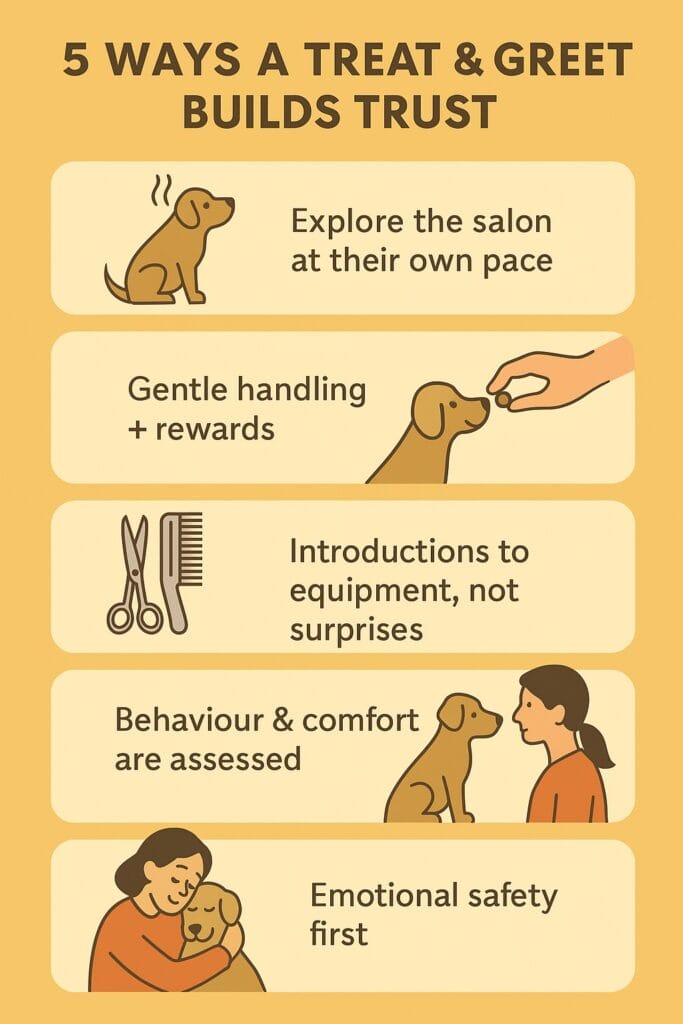
The dog explores the environment at their own pace
There’s gentle handling paired with praise or treats
They meet the groomer and sniff the tools and equipment
The groomer has time to observe behaviour, posture, movement, skin condition, and emotional responses
There’s no clipping or bathing — just trust-building
While the focus is often on the dog, Treat & Greets are also an important opportunity for open, two-way communication between groomer and guardian:
Guardians can share grooming history — at home or in other salons
Goals and preferences can be discussed (style, problem areas, sensitivities)
Any pain issues, medical conditions, or behavioural concerns can be highlighted
Realistic expectations can be explained without time pressure
These sessions also allow the groomer to spot subtle mobility issues or discomfort that might affect handling — something that’s easy to miss in a busy, time-pressured appointment.
Treat & Greets help build trust across all three corners of the relationship: dog, guardian, and groomer. They create space for transparency, honesty, and a shared understanding of what’s best for the individual dog.
They’re also a chance to explore whether the salon environment — and the approach it uses — is the right fit for the dog and guardian. Equally, it allows the groomer to consider whether the needs and expectations of the guardian align with the service being offered. It’s all about setting everyone up for success, from the very first visit.
The Science Behind It
Dogs Are Emotionally Like Toddlers
According to canine behaviour researcher Stanley Coren, dogs have the cognitive and emotional maturity of a two to two-and-a-half-year-old child (Coren, 2004). Like toddlers, they can be overwhelmed in new places — especially when unfamiliar sights, sounds, and handling are involved.
They learn through repetition and experience, forming strong emotional associations that stick — good or bad.
First Impressions Stick — and Dogs Remember
Unlike humans, dogs often retain long-term memory for experiences, commands, and emotional responses from an early age. Coren (2024) recounts the story of a dog taught Czech commands as a pup, who responded to them perfectly seven years later despite living with English speakers.
This kind of memory applies not just to words, but to emotional experiences too — reinforcing the importance of making a dog’s first visit to a new salon a positive one.
How Treat & Greets Help Rewrite the Story
Even dogs with previous grooming experience may carry unseen emotional associations that affect how they respond in a new salon. A particular smell, sound, or type of handling might remind them — consciously or not — of a past experience that caused discomfort or fear.
Research into fear memory and classical conditioning confirms that dogs often react emotionally to environmental triggers long after the original event has passed — especially if restraint, pain, or anxiety were involved (Overall, 2013).
Emotional responses aren’t the only factor shaping how a dog copes in the salon. Pain from arthritis, stiffness, injury, or underlying medical conditions can also cause anxiety or reactivity during handling. Treat & Greets allow time to gently assess these factors — helping to avoid unnecessary stress and adapt future sessions accordingly.
Treat & Greets offer a valuable opportunity to begin rewriting those emotional responses by creating a safe, positive, and pressure-free introduction. Given time and the right support, dogs can learn that grooming doesn’t have to be stressful — even if past experiences taught them otherwise.
Stress, Grooming, and the Importance of Positive Introductions
Studies show that rushed or overwhelming grooming experiences can increase stress responses in dogs — from raised heart rate to elevated cortisol levels. Behaviour-based techniques like desensitisation and counter-conditioning are well-established methods for helping animals build positive responses to things they previously feared or avoided (Overall, 2013).
A Treat & Greet lays the foundation for that process.
Why It’s Worth Asking About Treat & Greets
Client feedback from across the industry shows that one of the most common sources of dissatisfaction with grooming services is a lack of communication — around how a dog is handled, what’s possible in a single session, or how to support a nervous dog (Clipit Grooming, 2023; Groomer Nation, 2023).
A Treat & Greet helps prevent misunderstandings by slowing things down and giving space for everyone to be heard — before a pair of clippers even touches the dog.
Many professional, welfare-focused groomers now offer some form of introductory session. Dog guardians are encouraged to ask:
What happens during the Treat & Greet?
How does the groomer assess the dog’s emotional state and physical needs?
Will there be time to talk through coat care, styles, or concerns?
How is the dog introduced to handling and tools?
These small first steps can make a huge long-term difference in how dogs feel about grooming.
Helping Dogs (and Their Guardians) Feel Confident
Grooming shouldn’t be rushed, forced, or based purely on appearance. With the right approach, it can become something far more meaningful — a calm, cooperative process that supports dogs emotionally as well as physically.
Grooming is about the whole dog — not just how they look. That means adjusting techniques to suit a dog’s age, physical condition, and emotional comfort level. Whether a dog is recovering from injury, slowing down in their senior years, or just needs more time to feel safe, low-stress grooming begins with meeting them where they are.
Treat & Greets are a simple but powerful way to start that journey.
Why We’ve Made Treat & Greets Standard at Blue-Bee Dog Grooming
At Blue-Bee Dog Grooming, we’ve made Treat & Greet sessions a standard part of every new client journey — not as an optional extra, but as an essential first step.
By taking the time to build trust from the beginning, we’re setting each dog up for a more positive, cooperative experience — one that supports both their emotional wellbeing and long-term grooming success.
References
Clipit Grooming (2023) Giving Good Customer Service as a Groomer. Available at: https://www.clipit-grooming.com/post/giving-good-customer-service-as-a-groomer [Accessed 5 July 2025].
Coren, S. (2004) How Dogs Think: Understanding the Canine Mind. New York: Free Press.
Coren, S. (2024) ‘Who’s a clever boy? The average dog has a mental age of about two – but what are they really thinking?’, The Guardian, 26 April. Available at: https://www.theguardian.com/lifeandstyle/2025/apr/26/whos-a-clever-boy-the-average-dog-has-a-mental-age-of-about-two-but-what-are-they-really-thinking [Accessed 5 July 2025].
Groomer Nation (2023) Mastering Client Communication to Elevate Your Pet Grooming Business. Available at: https://www.groomernation.com.au/post/mastering-client-communication-to-elevate-your-pet-grooming-business [Accessed 5 July 2025].
Overall, K.L. (2013) Manual of Clinical Behavioral Medicine for Dogs and Cats. St. Louis, MO: Elsevier.